Research
Overview
We study how electricity drives chemical reactions at electrode surfaces. Our goal is to understand electron-transfer-driven processes well enough to build molecules step by step on surfaces, controlling each elementary step with the electrode potential.
We apply this understanding to develop electrochemical processes that scale, from new routes for converting light alkanes to kilogram-scale synthesis for the pharmaceutical industry.
01How can we control every step of a surface reaction?
A catalytic reaction on a surface runs through a sequence of steps, such as adsorption, bond breaking and desorption, that each favor different conditions. Under a constant potential, the catalyst operates at a compromise between them.
We change the electrode potential over time so that each step runs under the conditions that suit it. With this approach, we activate the C–H and C–C bonds of light alkanes at room temperature and follow how surface species form and react in real time.
02Why and how does electricity drive chemical transformations?
Which steps of a reaction does the electrode potential actually accelerate, and what role does the molecular environment at the interface play?
We measure how reaction rates respond to the potential and to the composition of the interface, including cations, anions, proton donors and solvent, to identify the elementary steps involved. In CO₂ reduction, for example, we found a concerted proton–electron transfer pathway that makes the reaction considerably more energy efficient.
03How do we take electrochemistry to scale?
Electrochemical reactions that work well in a small cell often behave differently at larger scale, because mass transport, current distribution and heat removal change. We connect the reaction mechanism with mass transport to design processes that scale predictably.
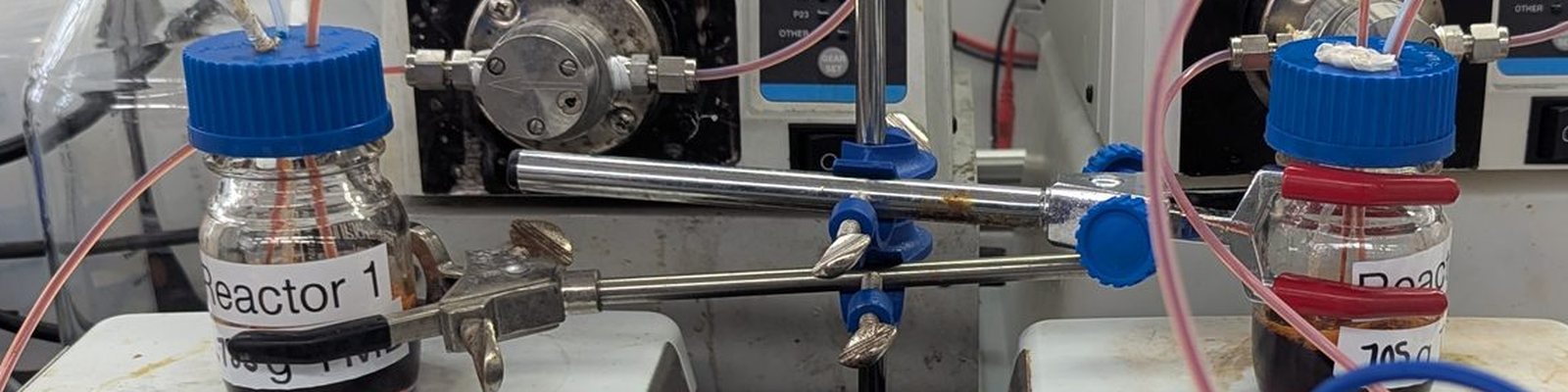
With Bristol Myers Squibb, we developed a Ni-catalyzed cross-electrophile coupling that runs at kilogram scale in flow. With the Wickens group, we scaled up an electrochemical C–H functionalization.
- Scaling organic electrosynthesis: The crucial interplay between mechanism and mass transport, ACS Cent. Sci. 2025
- Development of kilogram-scale electrochemical Ni-catalyzed cross electrophile coupling in flow, Org. Process Res. Dev. 2026
- Stereo-reversed E2 unlocks Z-selective C–H functionalization, Science 2025
04How do we see reactions as they happen?
We follow reactions while they happen: electrochemical mass spectrometry detects products and intermediates in real time, and in-situ Raman and surface-enhanced infrared spectroscopy (SEIRAS) show which species sit on the electrode surface. We combine these measurements with electrochemical kinetics and kinetic modeling.
Photos of our instruments and setups are on the lab life page.
Funding
We thank the following organizations for supporting our work: